
 Posts
Posts


Born and grew up in a very conservative country until after college when I came over for graduate school, I was curious to learn about how American girls grew up in the relatively conservative decades. Will this novel represent the rite of passages of American girls from girlhood to womanhood in the 70's? I am not sure that it does since I didn't grew up here. It would be a hard way for girls to grow up if this novel does represent the culture. I felt sorry for the heroine, Evie.
This novel is long, from Evie's first love in high school, the turns and twists of her relationships, her financial struggles while in college, and her realization of her place at the end. I wouldn't say this is a classic, only time will tell. However, it's a novel worth reading if one has the patience.
Sunday, May 9, 2010
Sunday, February 21, 2010
In the Grip of Bereavement, by Dr. Chaim Licht
When it comes to deal with the loss of loved one, everyone grieves differently and every culture has its own unique custom as to the proper way of mourning.
Dr. Licht's daughter didn't live to see her thirtieth birthday. In his grief, he turned to Jewish literature of the Aggada to explore the responses of the sages to similar situation. In this three-part book, he meticulously analyzed the ten aggadic stories on death and bereavement from Jewish perspective.
Initially, this book didn't hold my interest as I have had very little exposure of ancient Jewish history and literature. It took me awhile to finish reading it and I am glad that I did. I feel that I just took an ancient Jewish literature course.
While this book may not be for me and I am neutral about it, however, I believe that for Jews or those with deep knowledge of ancient Jewish history and literature, this book would be a nice addition to their book collection.
Dr. Licht's daughter didn't live to see her thirtieth birthday. In his grief, he turned to Jewish literature of the Aggada to explore the responses of the sages to similar situation. In this three-part book, he meticulously analyzed the ten aggadic stories on death and bereavement from Jewish perspective.
Initially, this book didn't hold my interest as I have had very little exposure of ancient Jewish history and literature. It took me awhile to finish reading it and I am glad that I did. I feel that I just took an ancient Jewish literature course.
While this book may not be for me and I am neutral about it, however, I believe that for Jews or those with deep knowledge of ancient Jewish history and literature, this book would be a nice addition to their book collection.
Sunday, February 7, 2010
Restful Insomnia, by Sondra Kornblatt
I sleep like baby, so I was not very thrilled when LibraryThing notified me that I had won the right to review this book. However, as I was reading this book I felt very sorry for those who suffer from insomnia. Not only sleep doesn't easily come by for them, but also the complicated techniques and tips to deal with sleepless weaving throughout this book that I had hard time get it.
I am neutral about this book. Maybe someone else with chronicle sleep disorder will find it useful.
I am neutral about this book. Maybe someone else with chronicle sleep disorder will find it useful.
Saturday, January 23, 2010
Prime-Time Health, by William Sears, MD
This is a great book that covers head-to-toe, inside-and-outside of how human body changes as we age. Based on scientific evidence, his own medical practice, and his own experience as cancer survivor, Dr. Sears, in a easy to understand and sometimes humorous way, presents a wealth of information as to what to do, what to eat, and how to do it so to live a healthy, happy life in prime-time as we age.
I couldn't put this book down when I was reading it. Though I have already maintain quite a healthy diet and exercise program for may years, I find that I can fine tune my ways based on the information that Dr. Sears shares in this book.
I highly recommend this book without any reservation.
I couldn't put this book down when I was reading it. Though I have already maintain quite a healthy diet and exercise program for may years, I find that I can fine tune my ways based on the information that Dr. Sears shares in this book.
I highly recommend this book without any reservation.
Saturday, December 26, 2009
2009 in review
2009 is about to end in a few days, it's quite an eventful year with turns and twists that keeps me extremely busy, it's also the year that marks my 30 years living in the United States.
First of all, thanks God my mother is still vibrant at the advanced age of 85. She even learned how to sit in front of computer, look into the webcam, speak into the microphone while taking my calls on Skype.
2009 is the year that brings many happy events to my extended families. Niece Michelle was blessed with a bouncing baby boy in April, nephew Barry got married to his beautiful bride Lin-wei in June when I traveled to Taiwan for, nephew Benson's wife, Ching-yen, is expecting, and niece Ya-ching was accepted into the 4-year BS program in the Department of Nursing at Chang Gung Institute of Technology.
2009 is also the years that brings devastating event to my extended families. When the deadly typhoon Morakot hit Taiwan, with it one of my younger brothers sustained a total loss of his fish farm, thus his way of living. With the support of my siblings, he will rebuild. I had a painful discovery of how blood relations can be in such a discord that I had to lobby so hard to gain the support for him.
However, the Fall of 2009 also brought two of my brothers to California. I had great time with them while they were here.
As for me personally, 2009 marks the 30th year that I have lived in the United States. When I arrived here on August 15th, 1979 as a graduate student, little did I know that I would make it here.
At work, I had the busiest year in my career as I had to step in for a consultant who was out of the country for two months when his mother was dying. I practically worked seven days a week in that period. Since I am given more responsibility at work, I don't see it will ease up anytime soon. 2010 will be a very busy year as well.
On my literary program, I finished reading five novels by Edith Wharton (1862-1937) and four novels by E. M. Forster (1879-1970). This concluded my reading of six authors out of twenty-eight in the Library of Essential Writers Series published by Barns & Noble.
In 2009, I still make it a priority to exercise five times a week with a well balanced exercise program, and I also pay more attention on nutrition. As a result, I can't be happier when my doctor gave me a clean bill of health and my weight stays the same as last year.
Last but not least worth mentioning was my visit to Taipei Hoping Church in June, where I had the chance to reconnect with some college friends and meet some new friends. I pray to God that these friendships will last.
First of all, thanks God my mother is still vibrant at the advanced age of 85. She even learned how to sit in front of computer, look into the webcam, speak into the microphone while taking my calls on Skype.
2009 is the year that brings many happy events to my extended families. Niece Michelle was blessed with a bouncing baby boy in April, nephew Barry got married to his beautiful bride Lin-wei in June when I traveled to Taiwan for, nephew Benson's wife, Ching-yen, is expecting, and niece Ya-ching was accepted into the 4-year BS program in the Department of Nursing at Chang Gung Institute of Technology.
2009 is also the years that brings devastating event to my extended families. When the deadly typhoon Morakot hit Taiwan, with it one of my younger brothers sustained a total loss of his fish farm, thus his way of living. With the support of my siblings, he will rebuild. I had a painful discovery of how blood relations can be in such a discord that I had to lobby so hard to gain the support for him.
However, the Fall of 2009 also brought two of my brothers to California. I had great time with them while they were here.
As for me personally, 2009 marks the 30th year that I have lived in the United States. When I arrived here on August 15th, 1979 as a graduate student, little did I know that I would make it here.
At work, I had the busiest year in my career as I had to step in for a consultant who was out of the country for two months when his mother was dying. I practically worked seven days a week in that period. Since I am given more responsibility at work, I don't see it will ease up anytime soon. 2010 will be a very busy year as well.
On my literary program, I finished reading five novels by Edith Wharton (1862-1937) and four novels by E. M. Forster (1879-1970). This concluded my reading of six authors out of twenty-eight in the Library of Essential Writers Series published by Barns & Noble.
In 2009, I still make it a priority to exercise five times a week with a well balanced exercise program, and I also pay more attention on nutrition. As a result, I can't be happier when my doctor gave me a clean bill of health and my weight stays the same as last year.
Last but not least worth mentioning was my visit to Taipei Hoping Church in June, where I had the chance to reconnect with some college friends and meet some new friends. I pray to God that these friendships will last.
Friday, November 27, 2009
Charity begins at home
When the deadly typhoon Morakot hit Taiwan, it's force not only took hundreds of lives but also wiped out the livelihood of hundreds of thousands, especially villagers, farmers, and fishermen.
In my wildest dream, it never occurred to me that one of my very own would completely loss his way of living; that one of my younger brothers would not be able to continue his business raising fishes in his fish farms. The damage was so severe that it's beyond repair.
I felt a pang of concern when I leaned about it. What' would happen to his college-bound daughter? Would she need to drop her inspiration of a good college education? How about his two younger children? Would they end up growing up so fast as the result of the family misfortune thus innocents lost?
How could I not help my own sibling in disaster and my own nephew and nieces while I am living in the world's richest country, having a professional job with a respectable income? I couldn't look the other way, I had to do something to help him. Fortunately, my other brothers responded to my call that we ought to help him rebuild his business, and my sister agreed with me that we ought to support our college-bound niece in her college education.
As I am anxious to see that my bother gets back on his feet as fast as he can, a slow process that tests my patience, I feel guilty to spend in this holiday season on a HDTV and a media console, a replacement of my 23-year old Sony that quited on me in August. How can I splurge thousands on entertainment while my own brother is still struggling? I can't allow myself to do so.
"Charity begins at home, but it shouldn't end there". But one ought to help one's own family before one helps other people, that's what family is for. Everyday, I pray to God that my brother can rise beyond his misfortune and stand on his ground again.
In my wildest dream, it never occurred to me that one of my very own would completely loss his way of living; that one of my younger brothers would not be able to continue his business raising fishes in his fish farms. The damage was so severe that it's beyond repair.
I felt a pang of concern when I leaned about it. What' would happen to his college-bound daughter? Would she need to drop her inspiration of a good college education? How about his two younger children? Would they end up growing up so fast as the result of the family misfortune thus innocents lost?
How could I not help my own sibling in disaster and my own nephew and nieces while I am living in the world's richest country, having a professional job with a respectable income? I couldn't look the other way, I had to do something to help him. Fortunately, my other brothers responded to my call that we ought to help him rebuild his business, and my sister agreed with me that we ought to support our college-bound niece in her college education.
As I am anxious to see that my bother gets back on his feet as fast as he can, a slow process that tests my patience, I feel guilty to spend in this holiday season on a HDTV and a media console, a replacement of my 23-year old Sony that quited on me in August. How can I splurge thousands on entertainment while my own brother is still struggling? I can't allow myself to do so.
"Charity begins at home, but it shouldn't end there". But one ought to help one's own family before one helps other people, that's what family is for. Everyday, I pray to God that my brother can rise beyond his misfortune and stand on his ground again.
Sunday, October 11, 2009
Guernica, by Dave Boling
Hiking in the Basque country is one of the hiking vacations that I want to do, so I was eager to read this book. However, it took me awhile to get into it, but I couldn't put it down when Boling started telling the devastating German bombing of Guernica, the heart of Basque country, on the eve of World War II.
In "Guernica", Boling skillfully weaves the histories of Spanish Civil War, World War II, and the creation of a mural Guernica by Picasso with the lives of fictitious characters from two families, the Ansotegui and the Navarro. He makes learning history less boring, at least for me.
In "Guernica", Boling skillfully weaves the histories of Spanish Civil War, World War II, and the creation of a mural Guernica by Picasso with the lives of fictitious characters from two families, the Ansotegui and the Navarro. He makes learning history less boring, at least for me.
Wednesday, July 29, 2009
The Song of Songs: A woman in love - Translation & commentary by Benjamin J. Segal
When I was in college in the early 70’s, I attended the regular Sunday services and youth activities in a Presbyterian church in Taiwan, where the culture was very conservative then, romantic love between man and woman was seldom openly discussed. My pastor focused on the Christian’s devotion to God when he mentioned the “The Song of Solomon”, he sort of avoiding the implied relationship between a man and a woman.
Rabbi Benjamin Segal translated and commented the “The Song of Songs” in a way that I had never thought of then. The title “The Song of Songs: A Woman in Love” clearly speaks that “The Song of Songs” is the book in Bible that celebrates the unconditional romantic love, it’s not just a book that emphases divine love to God. I found Rabbi Segal’s interpretations very interesting and liberating.
Rabbi Benjamin Segal translated and commented the “The Song of Songs” in a way that I had never thought of then. The title “The Song of Songs: A Woman in Love” clearly speaks that “The Song of Songs” is the book in Bible that celebrates the unconditional romantic love, it’s not just a book that emphases divine love to God. I found Rabbi Segal’s interpretations very interesting and liberating.
Saturday, May 23, 2009
Natural Treatments for Tics & Tourette's by Sheila J. Rogers
This book is my crash course about Tics & Tourette Syndrome. It clearly explains what the disease is, how it impacts the patients and people around them, the possible causes from environment and diet, the different treatment options that focus on natural remedies and the management of environment and diet. I am not a medical professional, but I always pay attention to what environment and diet can impact my health personally and that of my loved ones. If this disease struck myself or any of my loved ones, I would seek every treatment options, including the natural remedies described in this book. Coincidentally, shortly after I finished reading this book, ABC aired an episode of its 20/20 programs, "Teens Take on Tourette Syndrome" that reinforced my understanding of the disease, on Friday, 05/22/2009.
Friday, January 2, 2009
2008 in review
With a 4-day long weekend for the New Year holiday, there is plenty of time for me to reflect events in the past year and plan for the new year. Though the world-wide financial meltdown of 2008 had shaken the very foundations of every society on earth, it was a very good year for me, albeit, a hectic one.
On the home front, no misfortune or disease befell any of my relations in Taiwan except my eldest brother who underwent a rectal surgery to treat the severe hemorrhoids that he suffered during his biking adventure around Taiwan. Thanks God, he had a speedy recovery.
As for my 84-year old mother, she was as healthy as she could be consider her advanced age. I kept my weekly calls with her throughout 2008 and I called to wish her a happy new year on the eve of New Year. My weekly call is the one thing she always expect on Saturday mornings, she talks, I listen, it will not change for 2009 and for the years to come.
I was delighted when my youngest sister called to tell me the improvement of her depression, as a result, her relationship with my mother had taken a turn for the better. I couldn't help feeling a sense of relief, after years of efforts, that she began to see that blood is thicker than water regardless whether there was some perceived injustice and injury inflicted on her, and by and large the perception may not be always correct.
As the first daughter of my parents and the only unmarried child of their eight children, I feel it's my duty to keep the different family relationships in harmony. It has not been an easy job, especially in a huge family like mine, nevertheless, every effort counts and I intend to bear it.
One thing I did early in the year was to document my family tree so to provide a way for the younger generations to connect with their elders and their cousins regardless where we live. In May, I took a quick trip to Taiwan for the wedding of Benson, the son of my youngest brother. As all my nephews and nieces get to the marriageable age in the next 10 years or so, there will be many weddings to attend. In 2009, there is one in June and I probably will make the trip.
On the personal side, health first. I kept my weight at 112 pounds and all my vital signs in the healthy range, thanks to the years of healthy diet and exercise regimen and a very good family doctor. However, in two of my yoga classes, I experienced a sudden excruciating pain of my lower back and my right shoulder that prevented me from doing the yoga poses that I used to do easily. Since I have exercised and practiced yoga regularly for many years that should keep me in great shape, I thought that the pain would just go away with break from exercise and yoga for a week or two. Little did I know it took me more than four months of physical therapies to get back to near normal. I still feel a tingling sensation every now and then, maybe it's just the sign of aging after all. However, I am not ready to throw in the towel yet without doing every exercise that I can to reverse it.
On my literary project, I completed the reading of three novels by Russian writer Leo Tolstoy (The Cossacks, War and Peace, Anna Karenina) and four novels by English writer George Eliot (Adam Bede, The Mill on the Floss, Silas Marner, Middlemarch) in the Library of Essential Writers Series published by Barnes & Noble. I will release my review of each novel in the new year.
I also cataloged some of my books in LibraryThing site and got involved in its Early Reviewer program which publishers offer unpublished books for review before releasing them to general public. I need to complete the cataloging of all my books in the new year.
On the career, I am still working on this multi-year and hundreds of million dollars program for the same company that I joined in 2004. If everything goes as planned, I probably will retire within this program in five to seven years when I am ready to retire. The jury is still out, but everyone is hopeful since this is the most important strategic project the company has in 60 years.
On the financial side, I am still on a very solid ground as I suffer no more than everyone has suffered when world-wide financial meltdown shock the very foundations of every society on earth. Though it was a tremulous and scary year, I was shielded from it to some degree. For that, I am grateful.
Last but not the least memorable was my reconnection with Winya and through her with some Hoppingers that I may meet again. Life comes in full circle, we plan, God laughs, how wonderful it is!
On the home front, no misfortune or disease befell any of my relations in Taiwan except my eldest brother who underwent a rectal surgery to treat the severe hemorrhoids that he suffered during his biking adventure around Taiwan. Thanks God, he had a speedy recovery.
As for my 84-year old mother, she was as healthy as she could be consider her advanced age. I kept my weekly calls with her throughout 2008 and I called to wish her a happy new year on the eve of New Year. My weekly call is the one thing she always expect on Saturday mornings, she talks, I listen, it will not change for 2009 and for the years to come.
I was delighted when my youngest sister called to tell me the improvement of her depression, as a result, her relationship with my mother had taken a turn for the better. I couldn't help feeling a sense of relief, after years of efforts, that she began to see that blood is thicker than water regardless whether there was some perceived injustice and injury inflicted on her, and by and large the perception may not be always correct.
As the first daughter of my parents and the only unmarried child of their eight children, I feel it's my duty to keep the different family relationships in harmony. It has not been an easy job, especially in a huge family like mine, nevertheless, every effort counts and I intend to bear it.
One thing I did early in the year was to document my family tree so to provide a way for the younger generations to connect with their elders and their cousins regardless where we live. In May, I took a quick trip to Taiwan for the wedding of Benson, the son of my youngest brother. As all my nephews and nieces get to the marriageable age in the next 10 years or so, there will be many weddings to attend. In 2009, there is one in June and I probably will make the trip.
On the personal side, health first. I kept my weight at 112 pounds and all my vital signs in the healthy range, thanks to the years of healthy diet and exercise regimen and a very good family doctor. However, in two of my yoga classes, I experienced a sudden excruciating pain of my lower back and my right shoulder that prevented me from doing the yoga poses that I used to do easily. Since I have exercised and practiced yoga regularly for many years that should keep me in great shape, I thought that the pain would just go away with break from exercise and yoga for a week or two. Little did I know it took me more than four months of physical therapies to get back to near normal. I still feel a tingling sensation every now and then, maybe it's just the sign of aging after all. However, I am not ready to throw in the towel yet without doing every exercise that I can to reverse it.
On my literary project, I completed the reading of three novels by Russian writer Leo Tolstoy (The Cossacks, War and Peace, Anna Karenina) and four novels by English writer George Eliot (Adam Bede, The Mill on the Floss, Silas Marner, Middlemarch) in the Library of Essential Writers Series published by Barnes & Noble. I will release my review of each novel in the new year.
I also cataloged some of my books in LibraryThing site and got involved in its Early Reviewer program which publishers offer unpublished books for review before releasing them to general public. I need to complete the cataloging of all my books in the new year.
On the career, I am still working on this multi-year and hundreds of million dollars program for the same company that I joined in 2004. If everything goes as planned, I probably will retire within this program in five to seven years when I am ready to retire. The jury is still out, but everyone is hopeful since this is the most important strategic project the company has in 60 years.
On the financial side, I am still on a very solid ground as I suffer no more than everyone has suffered when world-wide financial meltdown shock the very foundations of every society on earth. Though it was a tremulous and scary year, I was shielded from it to some degree. For that, I am grateful.
Last but not the least memorable was my reconnection with Winya and through her with some Hoppingers that I may meet again. Life comes in full circle, we plan, God laughs, how wonderful it is!
Sunday, December 21, 2008
Classical Christmas music
KDFC 102 FM is my favorite radio station. It is a commercial station in San Francisco Bay Area that broadcasts classical music 24 hours a day. It is also the radio home of the San Francisco Symphony and the San Francisco Opera. It is ranked among the top 3 Bay Area radio stations, and is the most popular classical station in the U.S.
On the weekdays, I wake up with its music at 5:30, indulge myself in the beautiful music for 15 minutes or so before I get up to get ready for work. Its music accompanies me at home and in the car. Whenever I travel out of town, I am always disappointed in the stations elsewhere.
During holiday season, it plays all-holiday blend of classical favorites through midnight on the 25th. You can listen it online with Windows Player, iTunes, or iPhone from KDFC Listen Online site. Here is the link http://www.kdfc.com/pages/743368.php.
On the first Sunday of every month at 8pm, KDFC broadcasts a full-length production of opera recorded live at San Francisco War Memorial Opera House, hosted by Dianne Nicolini. The link of San Francisco Opera on KDFC - http://www.kdfc.com/pages/743374.php.
The San Francisco Symphony on KDFC is another wonderful program that it plays highlights from the performances recorded live at Davies Symphony Hall. Here is the link http://www.kdfc.com/pages/743355.php.
Hope you enjoy it as much as I do. Merry Christmas!
On the weekdays, I wake up with its music at 5:30, indulge myself in the beautiful music for 15 minutes or so before I get up to get ready for work. Its music accompanies me at home and in the car. Whenever I travel out of town, I am always disappointed in the stations elsewhere.
During holiday season, it plays all-holiday blend of classical favorites through midnight on the 25th. You can listen it online with Windows Player, iTunes, or iPhone from KDFC Listen Online site. Here is the link http://www.kdfc.com/pages/743368.php.
On the first Sunday of every month at 8pm, KDFC broadcasts a full-length production of opera recorded live at San Francisco War Memorial Opera House, hosted by Dianne Nicolini. The link of San Francisco Opera on KDFC - http://www.kdfc.com/pages/743374.php.
The San Francisco Symphony on KDFC is another wonderful program that it plays highlights from the performances recorded live at Davies Symphony Hall. Here is the link http://www.kdfc.com/pages/743355.php.
Hope you enjoy it as much as I do. Merry Christmas!
Saturday, November 29, 2008
A heartfelt Thanksgiving
 |
| From when east meets west |
Thanksgiving Day is a day to give thanks for one's spiritual and material abundance. I remember my first Thanksgiving in 1979 with gratitude to a young American woman with whom I befriended at Neptune Hall, one of the graduate student dormitories in NIU, shortly after I arrived from Taiwan as a graduate student.
Since Thanksgiving is a federal holiday on the fourth Thursday of November, colleges and universities across the country operate on a shortened academic week, so is the residential dinning services. Alone and no place to go, I accepted Ellen's invitation to spend the Thanksgiving holiday with her family. They embraced me and introduced me to a traditional American Thanksgiving feast. After graduation, I lost contact with Ellen, but her kindness and the generosity that her family bestowed on me the real meaning of Thanksgiving years later when I started hosting Thanksgiving dinners.
Michelle, the daughter of my eldest brother, came to California for college in the late 1990's. Unfortunately, the relationship between us was incredibly strained and difficult. For years I agonized over the family feud caused by the discord between aunt and niece and her mother. And for years we were in non-speaking terms though we lived in the same region, in the same state most of the time. It's only until January this year, I left a message on her blog in it she detailed her infertility treatment. My heart ached for her that she had to endure the treatment, then the heartbreak when it didn't work for her. I wanted to refer her to a very good infertility specialist I know, after all, she shares the same blood with me. We were reconnected again, contacting each other sporadically, with great caution I was still hesitant to get involved in her life as those painful experience in the past was still vivid in my mind.
Late in April, she and Nick spent a day with me when I was getting ready for the trip to Taiwan for the wedding of Benson and Christy. We spent a few hours in my club, had a Thai lunch in downtown San Rafael, enjoyed the speculative view of San Francisco across the bay from the waterfront in downtown Tiburon, had delicious pastry at the famous Swiss Bakery there, and visited the chic downtown Mill Valley before they drove back to Walnut Creek. This was the first time that I had the opportunity to get acquainted with her husband, Nick, my new nephew-in-law whom I didn't know for years. The reunion after years of separation turned out fine, albeit with a little awkward moments every now and then throughout the day.
In September when Theresa, the daughter of my third elder brother, who lives in Japan hinted that Michelle would announce her pregnancy at the end of her first trimester for she feared of invoking great expectation from extended family if she made it known only to be disappointed again should it doesn't stick. I felt a pang of concern as to how she could handle the night-shift at a hospital where she works as RN? How she was doing, was it going to be alright this time? I called, offered my concerns and nutrition know-how, listened to her stories of morning sickness, and et cetera. She called when they learned it's a boy. From that point on, the relationship between aunt and niece made a more positive turn, the unborn baby served as the catalyst that helped transform years of family conflict into family peace.
Michelle and Nick were to come over for Thanksgiving. I wanted it to be a healthy, classic, and hearty American Thanksgiving dinner with all organic ingredients, including the turkey. I planned the menu and ordered a 12 pounds organic turkey from WholeFoods two weeks in advance and shopped all the ingredients the weekend before. On Thanksgiving Day, I got up at 5:30 in the morning, got the house ready, went to pick up the turkey and a bouquet of flowers from WholeFoods. By the time Michelle and Nick arrived around noon, I already baked the Cranberry Tea Bread, two Pumpkin Pies, and made the Apple & Sausage Dressing. Michelle help me make the Maple Cranberry Sauce and the Butternut Squash Apple Soup. She also washed and cut the onion, carrot, celery, turnip, baby green zucchini, baby yellow zucchini, sweet potato, lemon, and mushroom that were to be roasted with the turkey. Nick rubbed the herbs and sea salt mixture on the turkey before we set it on the bed of mix vegetables to be roasted for 3 hours and 10 minutes.  During the roasting, she also kept time at 30 minutes interval when we basted the turkey with the juice from the roasting pan so to keep it moist and flavorful. While the turkey was cooking in the oven, Nick was so fascinated by my collection of Spode china and silverware that he surfed the web for more information. I am afraid that he is going to start collecting the same pattern as well.
When the turkey was done, we made the gravy from the juices and drippings of the roasted turkey, set the table, took some pictures, I carved the turkey before we sat down. What a wonderful Thanksgiving feast we had! Everything turned out so delicious and tasty! We talked and laughed while enjoying the dishes and the red wine that Nick bought. After dinner, Michelle helped me clean up the dishes, pots and pans, I joked that it's not easy to have a Thanksgiving dinner, but we all felt that it all worth the trouble. Around 10:00 pm, they finally left my house with the a pumpkin pie, a loaf of cranberry tea bread, and container after container of leftovers.
I give thanks not only for the abundance of what I have, but for the heartfelt Thanksgiving that I had longed for finally came true. It always pains me a great deal when family conflict arises, especially as the result of crashes between two opposite cultures and two generations. As I get older, I am more keen on making conscious efforts in maintaining the family relationships that I have. At the end of the day, I want to be able to say that I have done everything I can do and I don't have any unfinished business with my family. God help me!
Note: This is one of my two Christmas catcus plants that bloom around Thanksgiving every year.
 |
| From when east meets west |
1. Organic Herbal Roasted Turkey
 |
| From when east meets west |
 |
| From when east meets west |
 |
| From when east meets west |
 |
| From when east meets west |
 |
| From when east meets west |
 |
| From when east meets west |
Sunday, November 16, 2008
The Last Gifts, by Jillian Brasch
My Dad was very ill for 7 months before he past away in 2005. When he was dying, I was looking for books that would give me practically ways, in addition to pray, to take care of him during the final journey of his life, but I found so little available. I finally realized that in the American culture that people in general are not comfortable around someone who is either dying or whose loved one is dying. It's very different from the culture in Taiwan where I was originally from. I felt so lonely and isolated then, wishing that there were more supports out there for me while I was dealing with the illness of my Dad.
I appreciate Ms. Jillian Brasch's contribution in this scarce field in a practically way. I highly recommend her book to anyone who needs it.
I appreciate Ms. Jillian Brasch's contribution in this scarce field in a practically way. I highly recommend her book to anyone who needs it.
Monday, November 3, 2008
What a hectic October!
I can't believe it's already November and Thanksgiving holiday is just around the corner. I was so busy at work this October that I worked two weekends in a row, but the work still keeps coming and my responsibility keeps increasing. There is no end in sight, at lease not for another five years in this 350 million dollar program!
In today's staff meeting, my boss told me to start planning the resources (time, cost, staff) for two new projects that I will be managing. It's exciting yet scary, how am I going to juggle them in addition to what I am doing now? Oh, boy! I just have to manage it!
One would think work should slow down as one approaches retirement in less than ten years, but that's not the case for me. I keep getting more and more responsibility as I get older. Is there anything wrong with it? When can I slow down and smell the roses?
In today's staff meeting, my boss told me to start planning the resources (time, cost, staff) for two new projects that I will be managing. It's exciting yet scary, how am I going to juggle them in addition to what I am doing now? Oh, boy! I just have to manage it!
One would think work should slow down as one approaches retirement in less than ten years, but that's not the case for me. I keep getting more and more responsibility as I get older. Is there anything wrong with it? When can I slow down and smell the roses?
Sunday, October 5, 2008
Father's cattleya
 It's the Spring of 1992, I was driving home from Stanford after a hectic day in the office, still tired from the jet lag from Taiwan where my mind was on, feeling that I needed something beautiful to lift me up, something that would remind me, year after year, of the reason why I took this emergency trip home.
Recalling a colleague talking about her botanical tour of a nursery with acres of orchids in South San Francisco, I made a detour off highway 280 onto El Camino Real, drove into the parking lot of Rod McClellan Co., Acres of Orchids, an orchid paradise and a Bay Area institution for a century until it closed in 1998 to make way for for high density housing development.
There were hundreds of beautiful orchids in the nursery, but my eyes were drawn to a display of showy, golden yellow cattleya. This was the one that I wanted to take home, I knew it when I saw it.
"Aren't they beautiful? They are from Raymond Burr's Sea God Nurseries." said a friendly female voice. I knew Raymond Burr was the actor in that popular, long running Emmy-winning American TV series, Perry Mason. It would be nice to have an orchid from his nursery.
But the cost for a full-grown, blooming plant was so high that I couldn't really afford it then in 1992. Disappointed, I was ready to leave but the lady took me to a table on which sat a dozen of orchid seedlings. They were the seedlings of those expensive ones that had caught my eyes, for thirty dollars I could have one and a hope that it would grow into an adult plant.
I decided to buy an inexpensive blooming dendrobium with purple flowers and a seedling of the beautiful cattleya, thought that I would cultivate the seedling for the rewards later. How naive I was! What if it didn't survive?
I put it on the kitchen windowsill where it's kissed by the gentle morning sun. I watered and fertilized it according to the care instructions, watched it grew into an adult plant, delighted by the beautiful flower on a single spike for a few years, divided them into two and into four as they out grew their pots. In the early Fall of 2002, all four plants bore such a beautiful flowers that brightened my house for a long time.
 After that, they stopped flowering until late this Summer, one of them surprised me with the same brilliant golden yellow flower that made my heart leap in joy again.
My father, after he retired from his business, used to cultivate orchids until his near fatal stroke at age 75 on the Eve of Chinese New Year in 1992. He laid unconsciously in the hospital for a month while my family withheld the news from me, for they didn't want to worry me since I just started a new job at Stanford Medical Center for a few months. How dare they were! He was my father! I was furious when I learned about it only after he regained conscious.
Took leave from my job, I flew back to Taiwan. By his bedside, I watched helplessly in his struggles to recover his lost motions and speeches. It pained me to see his frustrations over the slow progress to take control of his normal functions. I felt then that he was slipping away from me, from everyone who loved him dearly.
He eventually gained back a great deal of his strength, but life was never the same for him nor for my family. When I was nurturing the cattleya, maybe unconsciously I was also nurturing him hoping that he would be whole again. The cattleya grew and multiplied but he gradually withered away. Exactly thirteen years later, six days before Chinese New Year in 2005, he passed away after a very long illness. I realize it now, over the span of thirteen years, that I was saying good-bye to him in stages and this was the beginning of the long good-bye.
From one single cattleya seedling in a tiny pot, it has multiplied to six pots of adult plant. Last year when my cousin, Shirley, visited me from Los Angeles, I asked her to bring one back for Peggy. I often wonder how it does now? Does it ever flower there? I also wonder how he does in the underworld where he is so far away from his family?
Sunday, September 28, 2008
I left my heart in Portland, Oregon
When it comes to travel, I like it for leisure, but not for business. However, sometimes I do need to travel for my job, going away for a conference is one of those trips that I have to take.
Early this year, I was scheduled to attend the BCBSA 2008 Information Management Symposium held in Portland, Oregon in the third week of September, I waited until the last minute to book the flight, thought it would be an exhausting three days sitting in sessions that I was obliged to participate, little did I know it turned out to be a memorable trip as the City of Roses has captured my heart.
I flew out of Oakland airport on Alaska Airlines early Sunday morning. It's only five hundred and forty-three miles and the flight took one hour and fifty-five minutes. By the time when I checked into Portland Marriott Downtown Waterfront hotel, it's already noon. Since the symposium's registration and the welcome reception didn't start until 5:00 pm, and after the failed attempt, as none of the tour agents work on Sunday, by the hotel concierge to book a city tour for me, I decided to explore the city on my own.
Portland, Oregon is a city located near the confluence of the Columbia and Willamette rivers, where the Willamette runs through its downtown. It has ten drawbridges, that drawn up for the passages of riverboats, link the east and west side of the city, and a four-mile loop of walkway around the riverbank. My hotel is situated on the far south end on the water front.

 My first stop was to have lunch at Marina Fish House, a floating restaurant with exclusive view of downtown Portland and the Willamette River, that sits on the river a few blocks south of my hotel near Marquam bridge.

 I ordered a broiled salmon, but was surprised to see the waiter brought me a plate of petti pastries since I don't have sweet tooth and I normally shy away from sweets. Oh, I should know better that Sunday brunch always comes with a spread of baked goods, but how tempting it was with such a beautiful plate of petti pastries in front of me! I took a few bites, asked the waiter to take it away before I ate it all. It's an enjoyable first meal in Portland, not only the salmon was very fresh and delicious but also the extremely friendliness of the waiter. It's a pleasant dinning experience.
After lunch, I walked past a stretch of boutique shops, outdoor cafes, Standford's restaurant along the riverbank to catch the Streetcar to Powell's bookstore. Portland Streetcar is owned and operated by the City of Portland, free to public within the city center. I hopped into the first car in sight, just to find out it's a southbound car to the direction of Oregon Health and Science University when a friendly couple told me so. I needed to take the northbound car that runs through downtown.
 In this beautiful, golden yellow car, I struck a conversation with an old couple from the Midwest. They were in Portland waiting to board the riverboat for their cruise vacation. A woman came over sitting by me when she heard that I come from San Francisco area, that I was in Portland for a three-day conference, and that I wanted to explore Portland in a Sunday afternoon. She was a transplant from San Francisco area where her relatives are, and she was drawn to Portland by her natural beauty, the slower pace of life, and a city made for walkers. As the streetcar moved through the city center, she pointed out the area of interests to me, such as the public library, the film center, and the unique shops. She also suggested that, after my visit to the Powell's bookstore, I might visit Chinatown and the Portland Classical Chinese Garden as they are only a few blocks away.
 I thanked her, jumped off the car, snapped a shot of the streetcar, happily walked around looking for Powell's when I came upon these three young street musicians. I stood listening for a few minute, took a shot, willing dropped a greenback when the young girl beckoned me for a donation, then walked across the street into the bookstore.
 No wonder Powell's is the world largest independent bookstore, it sits on an entire city block with over one million of new and used books in the building. The books are housed in different rooms by categories in the Pearl room, the Red room, the Purple room, the Rose room, the Orange room, the Gold and Coffee rooms, the Green and Blue rooms. It's so big that one could spend days there without cover even an inch of it. I spent two hours in the Blue room where it houses shelves after shelves of literature. By the time I left, I picked up ten books to have the store ship them to my house in California.
 From Powell's, I walked eight blocks east to Chinatown, a tiny area of few blocks dotted with Chinese shops and restaurants, that looks fairly empty compared to that in San Francisco. But the sun never sets on the Chinese people and Chinese restaurants, anywhere I go there are Chinese restaurants and Chinatown, no matter how small it is.

 Portland Classical Chinese Garden is located at two blocks north of Chinatown. The garden is a joint effort between two sister cities of Portland and Suzhou, China. During the construction years, there were more than 60 Chinese artisans from China worked on building the garden. It's the most beautiful, authentic Chinese garden outside China and Taiwan that I have seen. I couldn't help feeling a sense of pride, as an American Chinese or a Chinese American. It felt like an oasis in the middle of a busy city, where authentic Chinese art of tea is served. Of course, I took my afternoon tea there.
As the sun gradually set, the streets were flooded with warm rays of sunshine inviting me to explore more, yet I didn't have enough time to visit the International Rose Test Garden, a five plus acres garden in Washington Park. Legend has it that in the early 1900's Portland had twenty miles of rose-bordered streets, as a result, Portland was known as "City of Roses".
After consulting my visitor's map, I decided to walk back to the hotel through Tom McCall Waterfront Park that runs along the west bank of the Willamette river for the length of downtown. It's approximate twenty blocks from the Chinese Garden to my hotel in a pleasant forty-five minutes walk.
There were two outings on the schedules of the Symposium, wine testing and dinner at Willamette Valley Vineyards on Monday night and Columbia River Gorge tour on Tuesday afternoon.

Willamette Valley Vineyards is in Salem, the capital of Oregon, located approximate fifty miles south of Portland. The tour lady explained how they make the different kind of wine, the labels made from different grapes from different vineyards, and the distinct test of each label. Since I am not a wine drinker, I didn't remember anything that she said. But I enjoyed the outing after a day of sessions sitting in the hotel conference rooms.
Tuesday afternoon's we picked up our own lunch box, boarded a bus heading to Columbia River Gorge, "a spectacular river canyon cutting the only sea-level route through the Cascade Mountain Range, 80 miles long and up to 4,000 feet deep with the north canyon walls in Washington State and the south canyon walls in Oregon State." It's so beautiful that I want to come back for a hiking vacation. I was so taken by the natural beauty that I wish to capture it with a better camera. Fortunately, there are so many great images on the Internet free for all to see.

 We had a quick stop at the vista first to get the best view of the gorge. The handsome building on the left is the visitor center. It's so windy that made the hair of Jennifer and mine fly.

 Next, we stopped at Multnomah Falls, the longest falls in the gorge area, for thirty minutes just long enough for a short hike a little close to the Falls. How I wish to have enough time to hike up to the head of the Falls!
Early this year, I was scheduled to attend the BCBSA 2008 Information Management Symposium held in Portland, Oregon in the third week of September, I waited until the last minute to book the flight, thought it would be an exhausting three days sitting in sessions that I was obliged to participate, little did I know it turned out to be a memorable trip as the City of Roses has captured my heart.
I flew out of Oakland airport on Alaska Airlines early Sunday morning. It's only five hundred and forty-three miles and the flight took one hour and fifty-five minutes. By the time when I checked into Portland Marriott Downtown Waterfront hotel, it's already noon. Since the symposium's registration and the welcome reception didn't start until 5:00 pm, and after the failed attempt, as none of the tour agents work on Sunday, by the hotel concierge to book a city tour for me, I decided to explore the city on my own.
Portland, Oregon is a city located near the confluence of the Columbia and Willamette rivers, where the Willamette runs through its downtown. It has ten drawbridges, that drawn up for the passages of riverboats, link the east and west side of the city, and a four-mile loop of walkway around the riverbank. My hotel is situated on the far south end on the water front.

 My first stop was to have lunch at Marina Fish House, a floating restaurant with exclusive view of downtown Portland and the Willamette River, that sits on the river a few blocks south of my hotel near Marquam bridge.
 I ordered a broiled salmon, but was surprised to see the waiter brought me a plate of petti pastries since I don't have sweet tooth and I normally shy away from sweets. Oh, I should know better that Sunday brunch always comes with a spread of baked goods, but how tempting it was with such a beautiful plate of petti pastries in front of me! I took a few bites, asked the waiter to take it away before I ate it all. It's an enjoyable first meal in Portland, not only the salmon was very fresh and delicious but also the extremely friendliness of the waiter. It's a pleasant dinning experience.
After lunch, I walked past a stretch of boutique shops, outdoor cafes, Standford's restaurant along the riverbank to catch the Streetcar to Powell's bookstore. Portland Streetcar is owned and operated by the City of Portland, free to public within the city center. I hopped into the first car in sight, just to find out it's a southbound car to the direction of Oregon Health and Science University when a friendly couple told me so. I needed to take the northbound car that runs through downtown.
 In this beautiful, golden yellow car, I struck a conversation with an old couple from the Midwest. They were in Portland waiting to board the riverboat for their cruise vacation. A woman came over sitting by me when she heard that I come from San Francisco area, that I was in Portland for a three-day conference, and that I wanted to explore Portland in a Sunday afternoon. She was a transplant from San Francisco area where her relatives are, and she was drawn to Portland by her natural beauty, the slower pace of life, and a city made for walkers. As the streetcar moved through the city center, she pointed out the area of interests to me, such as the public library, the film center, and the unique shops. She also suggested that, after my visit to the Powell's bookstore, I might visit Chinatown and the Portland Classical Chinese Garden as they are only a few blocks away.
 I thanked her, jumped off the car, snapped a shot of the streetcar, happily walked around looking for Powell's when I came upon these three young street musicians. I stood listening for a few minute, took a shot, willing dropped a greenback when the young girl beckoned me for a donation, then walked across the street into the bookstore.
 No wonder Powell's is the world largest independent bookstore, it sits on an entire city block with over one million of new and used books in the building. The books are housed in different rooms by categories in the Pearl room, the Red room, the Purple room, the Rose room, the Orange room, the Gold and Coffee rooms, the Green and Blue rooms. It's so big that one could spend days there without cover even an inch of it. I spent two hours in the Blue room where it houses shelves after shelves of literature. By the time I left, I picked up ten books to have the store ship them to my house in California.
 From Powell's, I walked eight blocks east to Chinatown, a tiny area of few blocks dotted with Chinese shops and restaurants, that looks fairly empty compared to that in San Francisco. But the sun never sets on the Chinese people and Chinese restaurants, anywhere I go there are Chinese restaurants and Chinatown, no matter how small it is.Portland Classical Chinese Garden is located at two blocks north of Chinatown. The garden is a joint effort between two sister cities of Portland and Suzhou, China. During the construction years, there were more than 60 Chinese artisans from China worked on building the garden. It's the most beautiful, authentic Chinese garden outside China and Taiwan that I have seen. I couldn't help feeling a sense of pride, as an American Chinese or a Chinese American. It felt like an oasis in the middle of a busy city, where authentic Chinese art of tea is served. Of course, I took my afternoon tea there.
As the sun gradually set, the streets were flooded with warm rays of sunshine inviting me to explore more, yet I didn't have enough time to visit the International Rose Test Garden, a five plus acres garden in Washington Park. Legend has it that in the early 1900's Portland had twenty miles of rose-bordered streets, as a result, Portland was known as "City of Roses".
After consulting my visitor's map, I decided to walk back to the hotel through Tom McCall Waterfront Park that runs along the west bank of the Willamette river for the length of downtown. It's approximate twenty blocks from the Chinese Garden to my hotel in a pleasant forty-five minutes walk.
There were two outings on the schedules of the Symposium, wine testing and dinner at Willamette Valley Vineyards on Monday night and Columbia River Gorge tour on Tuesday afternoon.


Willamette Valley Vineyards is in Salem, the capital of Oregon, located approximate fifty miles south of Portland. The tour lady explained how they make the different kind of wine, the labels made from different grapes from different vineyards, and the distinct test of each label. Since I am not a wine drinker, I didn't remember anything that she said. But I enjoyed the outing after a day of sessions sitting in the hotel conference rooms.
Tuesday afternoon's we picked up our own lunch box, boarded a bus heading to Columbia River Gorge, "a spectacular river canyon cutting the only sea-level route through the Cascade Mountain Range, 80 miles long and up to 4,000 feet deep with the north canyon walls in Washington State and the south canyon walls in Oregon State." It's so beautiful that I want to come back for a hiking vacation. I was so taken by the natural beauty that I wish to capture it with a better camera. Fortunately, there are so many great images on the Internet free for all to see.

 We had a quick stop at the vista first to get the best view of the gorge. The handsome building on the left is the visitor center. It's so windy that made the hair of Jennifer and mine fly.
 Next, we stopped at Multnomah Falls, the longest falls in the gorge area, for thirty minutes just long enough for a short hike a little close to the Falls. How I wish to have enough time to hike up to the head of the Falls!
 Our third and the last stop was the Columbia Gorge Hotel, a well-appointed Italian style villa built in 1921 with sweeping view of the river. It's such an enchanting place that I wish to come for a few days.
With an hour drive back to the hotel, we were late for dinner and a jazz concert, said so our bus driver and tour guide. Reluctantly, I got on the bus again wishing that I could stay a little longer.
The jazz concert was so loud, not my type of music, I slipped out of it with two of my colleagues right after dinner. We took a nice walk along the riverbank, ended up in McCormick's Fish House & Bar for a drink. I knew it when Stefan and Smit walked out of the concert with me that they would find an excuse for another drink. It's amazing to see how they opened up telling me about their family lives outside the office. We left the bar after an hour, I went to the exercise room for another thirty minutes on the treadmill, and they went to the bar in the hotel for another drink.
I left Portland for California around 2:30 pm on Wednesday, the last day of the Symposium. On my way home, I kept thinking how unusual it is that I left my heart in Portland, a city more European than American, a city so clean, made for walkers, the Powell's bookstore, the gardens, and the rivers are so attractive to me that I want to visit again.
Sunday, September 7, 2008
Reading The Cossacks by Leo Tolstoy
The Cossacks is the second of Leo Tolstoy's three best known novels that I had read this year, my first read was Anna Karenina, followed by War and Peace that I finished in August.
It was a short novel inspired by Leo Tolstoy's own time in "the Caucasus, a geopolitical, mountain-barrier region located between the two continents of Europe and Asia." It was published in 1863.
It is regarded by many Tolstoy scholars as a Tolstoy's semi-autobiographical story. The main character is Olenin, a young wealthy solider who leaves Moscow to be stationed in the Caucasus. There, he befriends with some Cossacks and begins to emulate their way of life in search of a more authentic one, an indication of Tolstoy's turn away from his own class and toward those closer to earth.
Olenin falls in love with a free-spirited local girl, Marianka, betrothed to another, Luka. Olenin feels he must keeps his love for Marianka to himself and not to disrupt the lives of his new friends. In this love triangle, he has a profound but short-lived spiritual awakening. In the end, Luka is killed but Marianka still does not choose Olenin, he losses both friendship and love, eventually returns to where he comes from.
This novel is so short, 96 pages in a volume of 1,526 pages, that I read it on the flight to Taiwan for a family wedding in May this year. Nevertheless, Tolstoy's skills in expressing the spiritual struggles of young Olenin, in describing the rough mountain terrain and the cultures, in exploring the birth and death of love, made it a wonderful read. It is also the first book that opened my eyes about Cossacks as an ethnic group that had played a major role in Russian history and literature, especially in wars against foreign invasion, as it is very evident in Tolstoy's vast, epic novel War and Peace.
It was a short novel inspired by Leo Tolstoy's own time in "the Caucasus, a geopolitical, mountain-barrier region located between the two continents of Europe and Asia." It was published in 1863.
It is regarded by many Tolstoy scholars as a Tolstoy's semi-autobiographical story. The main character is Olenin, a young wealthy solider who leaves Moscow to be stationed in the Caucasus. There, he befriends with some Cossacks and begins to emulate their way of life in search of a more authentic one, an indication of Tolstoy's turn away from his own class and toward those closer to earth.
Olenin falls in love with a free-spirited local girl, Marianka, betrothed to another, Luka. Olenin feels he must keeps his love for Marianka to himself and not to disrupt the lives of his new friends. In this love triangle, he has a profound but short-lived spiritual awakening. In the end, Luka is killed but Marianka still does not choose Olenin, he losses both friendship and love, eventually returns to where he comes from.
This novel is so short, 96 pages in a volume of 1,526 pages, that I read it on the flight to Taiwan for a family wedding in May this year. Nevertheless, Tolstoy's skills in expressing the spiritual struggles of young Olenin, in describing the rough mountain terrain and the cultures, in exploring the birth and death of love, made it a wonderful read. It is also the first book that opened my eyes about Cossacks as an ethnic group that had played a major role in Russian history and literature, especially in wars against foreign invasion, as it is very evident in Tolstoy's vast, epic novel War and Peace.
Sunday, August 31, 2008
A Friday afternoon with mother Hsiao
PREFACE TO "A Friday Afternoon With Mother Hsiao"
Mother Hsiao passed away on January 12th, 2009. I attended her memorial service at Saint Andrew's Presbyterian Church in Redondo Beach, California on January 17th. She was honored, praised, and remembered with love, respect and fond memory by her family, friends, and people who had received her help. When Peggy asked me whether I, who had the honor and pleasure to know her mother, would write an article in remembrance of mother Hsiao, this writing jumped into my mind instantly. I respectfully dedicate this work to late Mother Hsiao and her family.
Peggy was devastated when her father, Dr. Hwachyuan Hsiao slipped into coma in his sleep on June 27, passed away six days later on July 3 at age 92. After the funeral, she wrote a moving, heartfelt account of his passing, how everyone in her family survived the loss, and how they celebrated his life. Peggy has such a a stout heart and is such a caring soul that in her grief her only concern was the well-being of her mother and her family.
I met Peggy in Hopping church when I was away from home to college in Taipei. At age 18, I didn't know a thing about the world, didn't know how to take care of myself, was very confused and very unhappy, and was very much homesick as I was never left home before that. I struggled through most of my college years, got invited to Hopping church, though I stayed there until graduation I didn't quite grip the significance of the role and work that the Hsiao's family served for the church.
It was when I had an acute episode of diarrhea that Dr. Hsiao treated me free of charge and Isa took me into her home for care that planted the seed of my friendship with Peggy, to my delight, that got developed years later in America, and to my regret, that I didn't have the chance to develop it with Isa.
After Graduate School in the early 1980's, I took my first job at Hamilton Sundstrand, an aerospace company, in Rockford, Illinois. In the meantime, Peggy's husband did his residency at the University of Wisconsin-Madison medical center. I got reconnected with Peggy then and visited her often as it's only an hour drive from Rockford to Madison.
Two years later, I took an offer with American Airlines, relocated to its technology center in Tulsa, Oklahoma. I lost contact with Peggy until in 1986 when her husband started his practice in Southern California, and Fireman's Fund offered to move me to its headquarter in San Rafael, a lovely town north of Golden Gate Bridge. We met once again when I drove down to LA in the Spring of 1987.
As it often happened in life that people meet, go different ways as life demands cares that leave little time and energy for anything else, then reunite again by divine intervention. I lost contact with Peggy again until in the Autumn of 2004 when my second-cousin Shirley invited me to her church retreat in Southern California over the Labor Day long weekend. I didn't know that Peggy and Shirley have been attending the same church, Peggy didn't know Shirley and I were related, and Shirley didn't know that Peggy and I had known each other since I was 18. What a wonderful reunion! I was ecstatic! Since then, whenever I was down in LA, be for leisure of for business, I paid visits to Peggy's parents in Torrence.
I sent my condolence to mother Hsiao when Dr. Hsiao passed away, spoke with her over the phone a few weeks later. When Peggy told me that her mother was coming up north to Palo Alto to stay with her daughter and son-in-law (Bernice & Wenjai) during the last week of August, I called Bernice to plan my visit with them in a Friday afternoon.
Mother Hsiao, Bernice, and Wenjai received me warmly when I got to Palo Alto. Seeing mother Hsiao, my heart ached as I did when seeing my own Mom after the passing of my Dad in 2005. From my Mom, I understand how trying it is for woman who lost her beloved husband of more than sixty years. I just wanted to do something to cheer her up, to spoil her, just like I have been doing for my Mom.
I inquired about her health, made a fuss of her needing to gain a few pounds, just trying to find something that I could do for her. To my surprise, Mother Hsiao took my hand, walked over to the dinning table, sat down with me side by side, started inquiring me about how I have been doing, about my family, and about my marital status, the one thing that I don't talk too much about. Obviously, she cares! even in her own grief! So, I started showing her the pictures that I took for my nephew's wedding in Taiwan in May on my digital camera. I was so animated, happily explaining the scenes and people in the pictures, thought that it would be entertaining to her. But I wonder now whether I did the right thing then.
Mother Hsiao also talked about the events that led to the passing of her late husband, how they met, the obstacles that they had to overcome to get married, how they worked hard in their life together, her outstanding children and grandchildren, the joy of having great-grandchildren, and of her concern for her son's family since her late daughter-in-law passed away last year. As a matriarch of the big Hsiao's family, she cares about everyone while still grieving quietly in silence, thought I. I couldn't help admiring her for her strength and her deep faith in God.
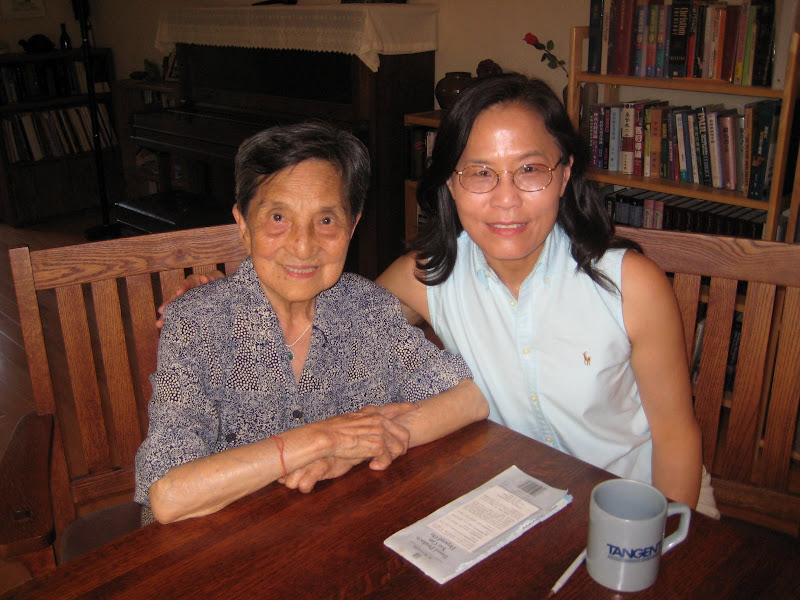
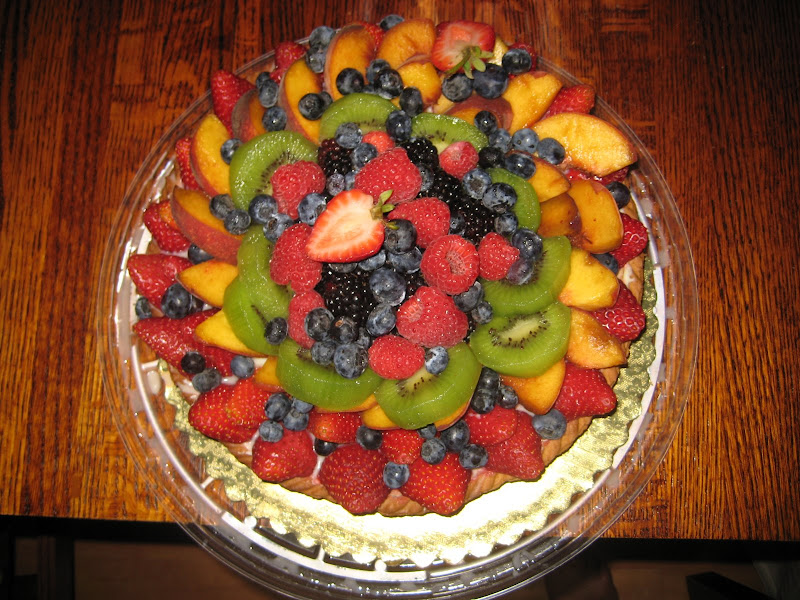
Time went fast, two hours had passed since I arrived. Her granddaughter Janet took a picture of mother Hsiao and me, and the fruit tart that we all enjoyed very much.
I lingered a little longer speaking with Bernice and Wenjai, had a 20-minute chair massage, visited their yard, finally bade my farewell, mother Hsiao took my hand and walked me over to my car.
Driving home to San Rafael, the image of mother Hsiao and what she said kept playing back vividly in my mind. What an amazing lady she is!
Sunday, August 24, 2008
Reading Anna Karenina by Leo Tolstoy
Anna Karenina is the second of two masterpieces written by Russian writer Leo Tolstoy. His first vast work is War and Peace. With The Cossacks, Barnes & Noble included these three novels, complete and unabridged, in its Library of Essential Writers Series published in 2007. I just finished reading Leo Tolstoy last week, Anna Karenina is my first reading of his works.
In Anna Karenina, Leo Tolstoy started with the most quoted line in literary world, "Happy families are all alike; every unhappy family is unhappy in its own way.", which I first saw in my youth without knowing where it was originated. This quote leads readers into a web of complicated love, relationships, families, the moral transgressions and the violations of social norm of Russian high society in the nineteenth-century, and in consequence the tragic death of Anna.
Anna Karenina was unhappily married to Alexei Karenin, fell madly in love with Alexei Vronsky, left her husband and son for Vronsky, gave birth to an illegitimate baby girl by Vronsky, despised by Vronsky's mother, and shunned by her friends in the high society. In the end, she threw herself down a train track, killed, when she perceived that her love for Vronsky was misplaced.
Prince Stephen (Stiva) Oblonsky, Anna's brother, was instrumental in obtaining a favorable divorce term from Alexei Karenin for his sister without much success. Stephen was married to Darya (Dolly) and cheated on his wife throughout most of their marriage. Darya chose to stay for the sake of their children, though unhappy yet secured a respectful position in the society. Darya was sympathetic and very kind to Anna while she was in an agony of despair for her position and was shunned by the society.
A sharp contract to the violent death of Anna was the joyous, honest and solid relationship of Levin and Kitty, who was Darya's youngest sister. Kitty rejected the proposal from Levin when she first met and fell in love with Count Alexei Vronsky. When she learned that Anna and Vronsky were together, she became very ill, went through a deep spiritual transformation, finally accepted Levin who always loved her. They lived a family life in the country, in sync with the social properties as understood by the nineteenth-century Russian high society.
If literature imitates life and the sociopolitical environment at the time of witting, Tolstoy definitely was the master in his time. I was awed by his ability to weave so many complex characters and events into seamless plots in the novel.
My copy of Anna Karenina is 832 pages long and it took me six weeks to read it during my daily commutes on the ferry from Marin to San Francisco in the months of April and May. This novel served me very well as my crash course into Tolstoy's works as it became easier for me to read his War and Peace later. I probably will read it again when I have all the time in the whole world in my retirement.
In Anna Karenina, Leo Tolstoy started with the most quoted line in literary world, "Happy families are all alike; every unhappy family is unhappy in its own way.", which I first saw in my youth without knowing where it was originated. This quote leads readers into a web of complicated love, relationships, families, the moral transgressions and the violations of social norm of Russian high society in the nineteenth-century, and in consequence the tragic death of Anna.
Anna Karenina was unhappily married to Alexei Karenin, fell madly in love with Alexei Vronsky, left her husband and son for Vronsky, gave birth to an illegitimate baby girl by Vronsky, despised by Vronsky's mother, and shunned by her friends in the high society. In the end, she threw herself down a train track, killed, when she perceived that her love for Vronsky was misplaced.
Prince Stephen (Stiva) Oblonsky, Anna's brother, was instrumental in obtaining a favorable divorce term from Alexei Karenin for his sister without much success. Stephen was married to Darya (Dolly) and cheated on his wife throughout most of their marriage. Darya chose to stay for the sake of their children, though unhappy yet secured a respectful position in the society. Darya was sympathetic and very kind to Anna while she was in an agony of despair for her position and was shunned by the society.
A sharp contract to the violent death of Anna was the joyous, honest and solid relationship of Levin and Kitty, who was Darya's youngest sister. Kitty rejected the proposal from Levin when she first met and fell in love with Count Alexei Vronsky. When she learned that Anna and Vronsky were together, she became very ill, went through a deep spiritual transformation, finally accepted Levin who always loved her. They lived a family life in the country, in sync with the social properties as understood by the nineteenth-century Russian high society.
If literature imitates life and the sociopolitical environment at the time of witting, Tolstoy definitely was the master in his time. I was awed by his ability to weave so many complex characters and events into seamless plots in the novel.
My copy of Anna Karenina is 832 pages long and it took me six weeks to read it during my daily commutes on the ferry from Marin to San Francisco in the months of April and May. This novel served me very well as my crash course into Tolstoy's works as it became easier for me to read his War and Peace later. I probably will read it again when I have all the time in the whole world in my retirement.
Sunday, August 17, 2008
Library thing
When my collection of books couldn't fit into the bookcase, they were all over the house and in the boxes. For a long time, I kept thinking that some of them must go, those that I won't read again, and I needed to get a new bookcase, preferably one with glass doors to keep the dust off.
I also wanted to catalog them so that I know when I acquire them, what I have read, what waiting to be read, how I feel about a specific book and the author's writing style, and so forth.
With these two aims in mind, during the Christmas holiday last year, I started shopping for a new bookcase cabinet, finally I settled on the Curio Cabinet in the Townhouse collection from Ethan Allen.
But how am I going to catalog them? I didn't want to use the old-fashioned Excel spreadsheet with its limited functionalities as it has to be stored on a hard drive in my home computer. I wanted a Web application that is accessible from anywere with rich functionalities. The technologist side of me knew there must be something available with Web 2 technology, so I searched the Net. Sure enough, there are quite few web sites offer the services, but I chosed the LibraryThing for its library-quality catalog and its capacity to connect me with people who read the same books.
Now the fun part began, I sorted out all my books into different piles, sent Salvary Army 6 shopping bags of books, and started adding books into my library. As of today, I cataloged 108 books and I am not done yet.
I have the entire collection of Library of Essential Writers published by Barnes & Noble since 2006. It's a collection of classic masterpieces by 28-writers, dated back to the 17th century, whose writings had not only greatly influenced generations of readers and writers, but also had profoundly impacted the Western clutures. It's my goal to read them all, and I found out that I am not alone through LibraryThing.
LibraryThing was developed by Tim Spalding in 2005. The online bookseller AbeBooks bought a 40% share of it in May 2006 for an undisclosed sum, and subsequently in July 2008, the world largest online retailer amazon.com acquired AbeBooks.
I also wanted to catalog them so that I know when I acquire them, what I have read, what waiting to be read, how I feel about a specific book and the author's writing style, and so forth.
With these two aims in mind, during the Christmas holiday last year, I started shopping for a new bookcase cabinet, finally I settled on the Curio Cabinet in the Townhouse collection from Ethan Allen.
But how am I going to catalog them? I didn't want to use the old-fashioned Excel spreadsheet with its limited functionalities as it has to be stored on a hard drive in my home computer. I wanted a Web application that is accessible from anywere with rich functionalities. The technologist side of me knew there must be something available with Web 2 technology, so I searched the Net. Sure enough, there are quite few web sites offer the services, but I chosed the LibraryThing for its library-quality catalog and its capacity to connect me with people who read the same books.
Now the fun part began, I sorted out all my books into different piles, sent Salvary Army 6 shopping bags of books, and started adding books into my library. As of today, I cataloged 108 books and I am not done yet.
I have the entire collection of Library of Essential Writers published by Barnes & Noble since 2006. It's a collection of classic masterpieces by 28-writers, dated back to the 17th century, whose writings had not only greatly influenced generations of readers and writers, but also had profoundly impacted the Western clutures. It's my goal to read them all, and I found out that I am not alone through LibraryThing.
LibraryThing was developed by Tim Spalding in 2005. The online bookseller AbeBooks bought a 40% share of it in May 2006 for an undisclosed sum, and subsequently in July 2008, the world largest online retailer amazon.com acquired AbeBooks.
Subscribe to:
Posts (Atom)